Understanding Historic Whaling Through Graph Theory: Insights from the 4-Oceans Workshop Presentation
Thursday, January 8th, 2026
At the recent 4-Oceans Workshop in Dublin, members of the EcoTwin team, Dr. Saikat Biswas and Dr. Rory Connolly, presented early results from a new attempt to understand historic whaling using modern data science. The work brings together thousands of historical records from the 4-OCEANS Global Leviathan Database, which contains geo-referenced entries spanning almost two thousand years and dozens of whale species. These records show where ships travelled, what they caught and how whale populations shifted over time.
Previous research has shown that climate shaped whaling activity. Sea-ice determined where whales and ships could go, winds influenced how far sailing vessels could travel and seasonal whale behaviour affected when they could be found. The challenge has always been separating these influences and understanding how they combined to shape human decisions at sea.
To tackle this, the team is experimenting with graph theory, a method that treats complex systems as networks of interconnected points. In this context, each point can represent things like locations, seasons, fleets or whale species, with connections showing how they influence one another. This allows researchers to test different scenarios and explore cause-and-effect in ways that traditional historical methods cannot.
As the presentation noted, early modelling is promising. Machine learning techniques such as LSTMs (Long Short-Term Memory networks) can detect recurring ecological events in the historical data, suggesting there are real environmental signals hidden in old records. Classification tests show that the models can already distinguish between several whale species with meaningful accuracy, even when species information is incomplete. Visual analyses also reveal clusters that group whale catches by similarities in time, place and biomass, hinting at shared ecological conditions.
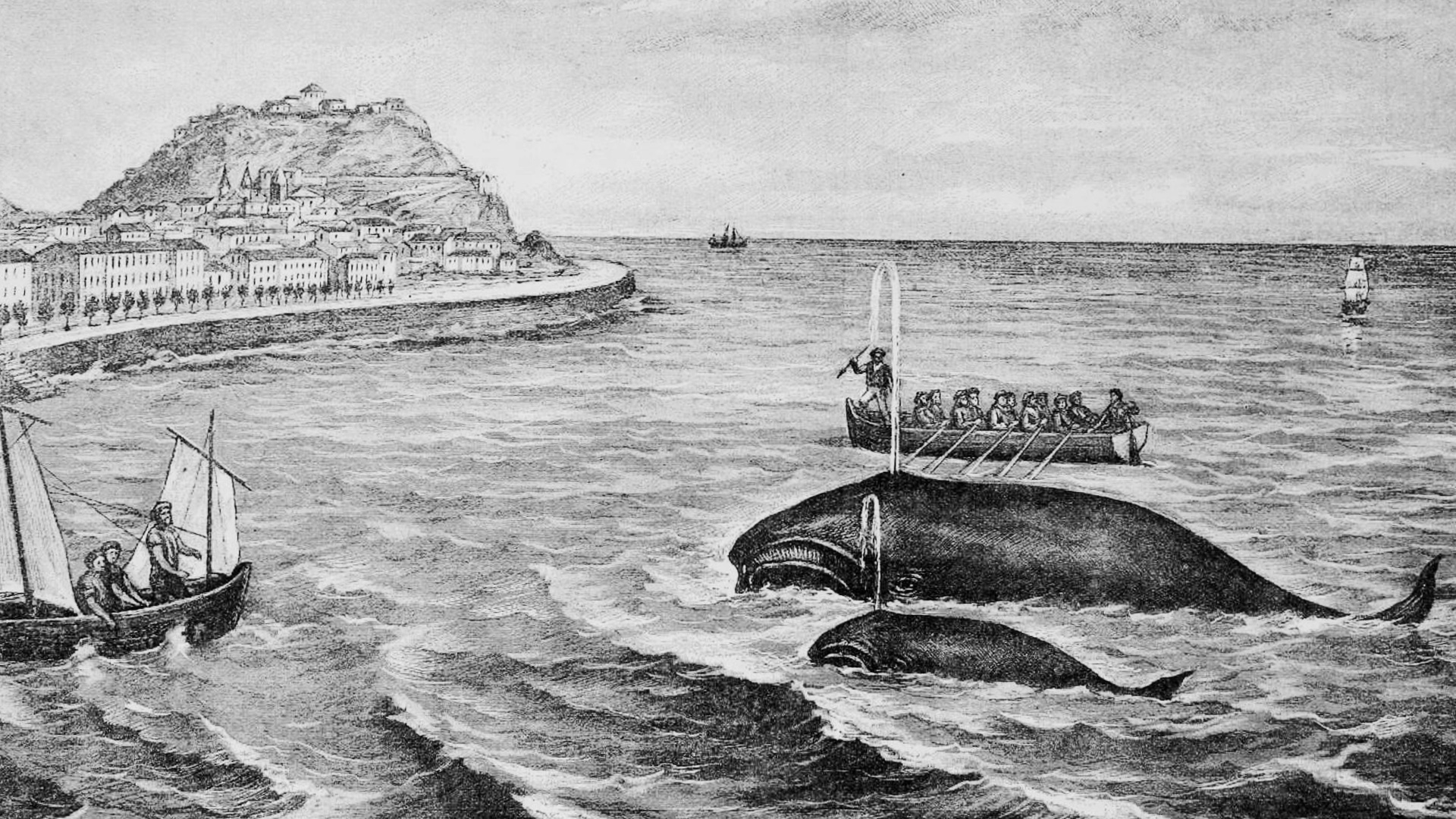
Image credit: Graells, M. P. 1870. Exploracion cientifica de las costas del departamento maritime del Ferrol, Madrid: 275-294.
The next step is to link these patterns to climate drivers. Volcanic eruptions, for example, can trigger short-term cooling that expands sea-ice and affects whale prey for several years. Longer-term ocean circulation changes, or shifts in phenomena like El Niño, can alter temperatures, nutrient supplies and storm tracks, all of which may leave fingerprints in whaling records .
Although the research is at an early stage, it shows strong potential. By pairing historical records with modern analytical tools, the team hopes to build a clearer picture of how climate, ecology and human activity interacted in the past. This could provide valuable insights not only for historians, but also for scientists working to understand long-term changes in marine ecosystems today.